
Women aren’t hitting the glass ceiling. They’re taking the side door.
Oct 21, 2026After a recent keynote, a woman from the audience stepped into the lift with me. She told me she had just withdrawn her interest in a promotion. It wasn’t that she didn’t want the role. She did. However, she had nothing left in the tank. She was carrying the bulk of the caring and domestic load for her two children, she had just started caring for her mother, who really needed to move into an aged care facility (but the waitlist was extensive) and she hadn’t slept properly in six months. She was experiencing anxiety in a way she never had before. No single factor did this. It was a collision of all of them at once. I refer to this as the “stress superstorm” in my Powered-Up Women keynote.
Sadly, her story isn’t unique. For the last few years I’ve heard far too many versions of it, and I’m no longer willing to whisper about them. These are ambitious, accomplished women who are exhausted, burnt out or sitting on the precipice of it, chronically stressed and quietly wondering what they’re doing wrong. They wonder why the bubble bath doesn’t fix it, or whether a new productivity app or a better planner is the missing piece.
It isn’t, because the problem was never theirs to fix.
HiBob’s 2026 study of 1,000 women and 1,000 men in Australian workplaces found 96 per cent of women are confident in their professional abilities, yet 35 per cent say they’re no longer interested in leadership. Their expectations of a promotion this year have fallen from 30 to 17 per cent. HiBob links that loss of interest to a pay gap that widens with seniority. I think women are weighing a second cost as well.
The pattern reaches all the way to the top. Chief Executive Women’s tenth Senior Executive Census found women’s share of ASX 200 executive leadership roles went backwards for the first time in a decade, from 32 to 31 per cent, and women received one in seven ASX 300 CEO appointments this year, down from one in four in 2025.
We’ve spent two decades talking about the glass ceiling. What I’m seeing is quieter. Capable women are slipping out the side door, stepping back from the promotion, leaning out (not in), turning down the stretch role or leaving altogether, because they are already operating at or beyond their capacity.
This isn’t only a story about women in leadership. It’s most visible there, because that’s where the pipeline is counted and the cost is the hardest (and most expensive) to ignore. But anecdotally, I hear that the Gender Capacity Gap is showing up at every level of an organisation, and the Deloitte, HiBob and Gallup data reflect women in all kinds of roles, not just senior ones.
The pattern in the data
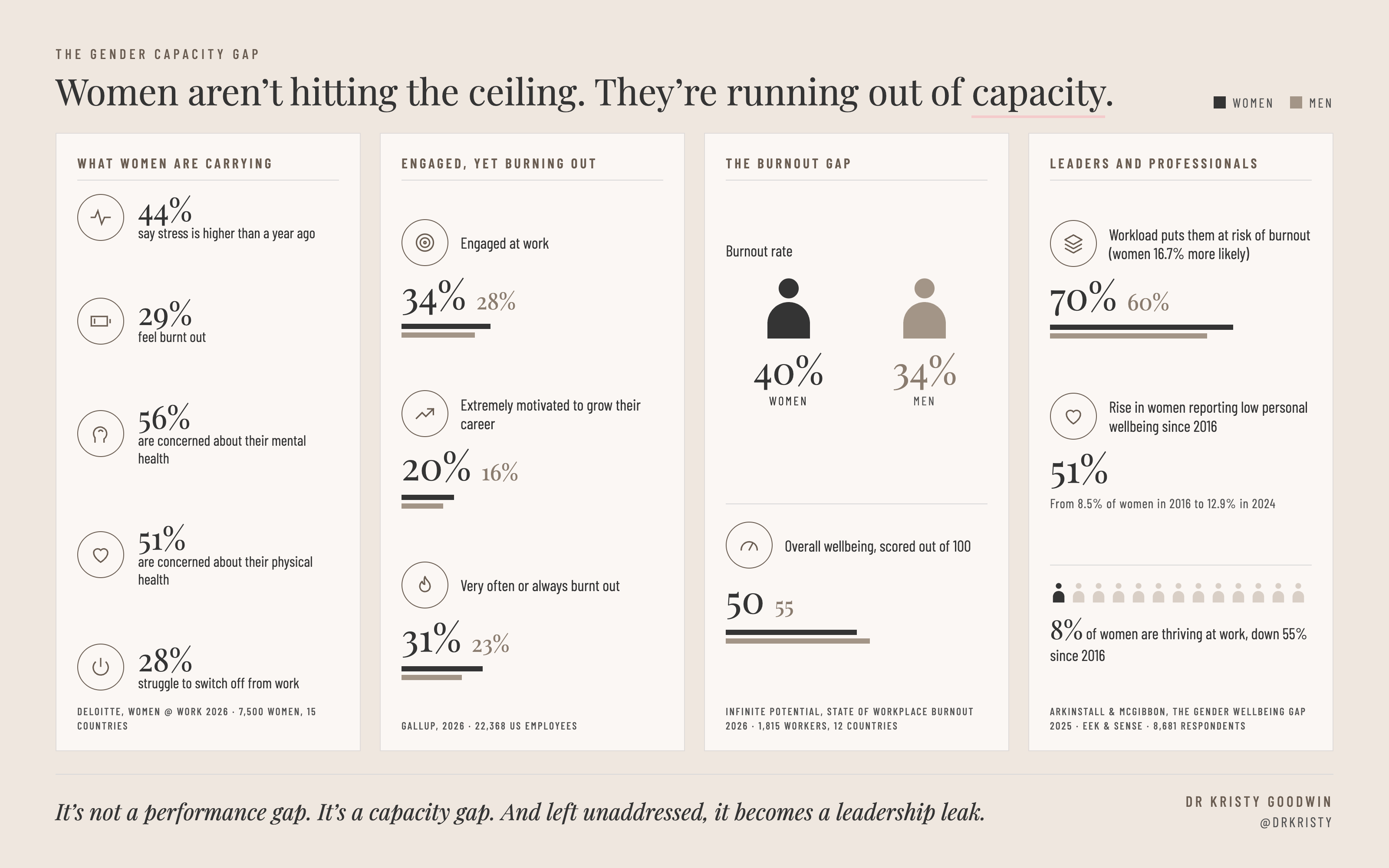
Deloitte’s Women @ Work 2026 report surveyed 7500 women across 15 countries. Forty-four per cent say their stress is higher than a year ago, and 53 per cent say doing their job alongside their home responsibilities doesn’t feel manageable.
Infinite Potential’s State of Workplace Burnout 2026, a study of 1815 workers across 12 countries released this week, puts women’s burnout rate at 40 per cent, against 34 per cent for men.
Gallup’s survey of 22,368 US employees shows why this isn’t an ambition problem. Women are more engaged than men, 34 per cent against 28 per cent, and more likely to be extremely motivated to explore career growth, 20 per cent against 16 per cent. Yet 31 per cent of women say they “very often” or “always” feel burned out at work, compared with 23 per cent of men. These women haven’t stopped caring. They care, and they’re running out of capacity to carry it.
The Global Leadership Wellbeing Survey’s 2025 Gender Wellbeing Gap report, by psychologists Carly Arkinstall and Audrey McGibbon, drew on 8681 leaders and professionals and found 70 per cent of women say their workload puts them at risk of burnout, compared with 60 per cent of men, which makes women 16.7 per cent more likely to feel that risk. Only 8 per cent of women now say they’re thriving at work, a 55 per cent drop since 2016, and the share reporting low wellbeing in their personal lives has risen by 51 per cent.
Peanut’s Motherhood Index 2026, a survey of 4000 mothers, found 93 per cent experience burnout and 70 per cent get fewer than five hours of unbroken sleep a night.
It’s not a performance gap. It’s a capacity gap. And left unaddressed, it becomes a leadership leak.
The biology behind the side door
Ambition is a forward-planning act, and it runs through the prefrontal cortex. That’s the same region holding every open loop a woman carries: the care arrangement that might fall through, the appointment still to book, the meeting that could run over pick-up. Under sustained stress or when chronically tired, it’s also the first region to lose efficiency. Add in what I refer to as “Role Ricochet”, the speed at which many women move between leader and carer with no transition time, and there is little Biological Bandwidth left for the next role. Our capacity is depleted.
When a capable woman tells me she isn’t interested in the next role, I’m not convinced we’re hearing a verdict on her drive. We may be hearing a rational calculation that the Success Tax on that promotion is more than her Human Operating System (hOS), this is what I describe as her brain and body’s basic biological design, can pay.
The problem with “good”
In that same Peanut survey, 61 per cent of mothers describe their mental wellbeing as good, even as 93 per cent report burnout. Ask a depleted woman if she’s okay and she will often say yes. That’s why engagement scores miss the leak until the resignation letter arrives.
Every woman who leaves through the side door is a succession gap and a retention cost that rarely reaches a board paper. Under Australia’s psychosocial hazard regulations, it’s also a risk employers are already obliged to manage.
Why I’m measuring it
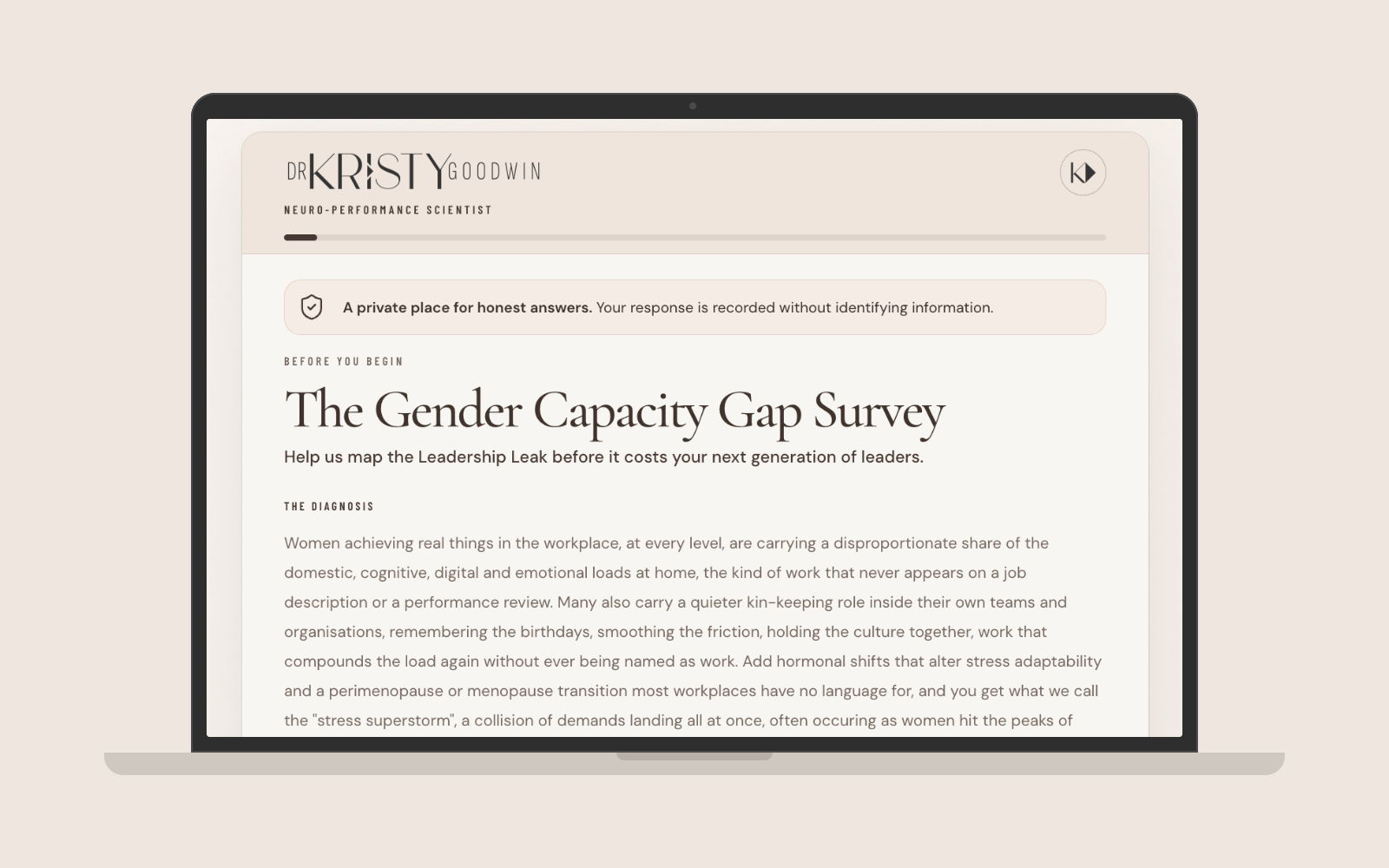
None of these studies tells us what sits underneath the gap for Australian women, or the moment a woman decides the next role isn’t worth what it will cost her. So I’ve built the Gender Capacity Gap survey. It’s open to women in every role. Your responses are recorded without identifying information. Once you’ve completed the survey, you can choose to enter a draw to win a 90-minute performance coaching call with me.
If you’re leading this conversation inside your organisation, or curating an International Women’s Day 2027 event, let’s organise a time to chat. I’d love to explore what that could look like in your room.

References
Arkinstall, C., & McGibbon, A. (2025). The Gender Wellbeing Gap 2025: A GLWS insights paper. EEK & SENSE.
Barry, K., & James, M. P. (2026, March 7). Women show stronger employee engagement amid higher burnout. Gallup. https://www.gallup.com/workplace/702881/women-show-stronger-employee-engagement-amid-higher-burnout.aspx
Chan, F. M. (2026). The State of Workplace Burnout 2026. Infinite Potential.
Chief Executive Women. (2026). CEW Senior Executive Census 2026. https://cew.org.au/hubfs/Census%20Web%20Stuff%202026/2026%20CEW%20Senior%20Executive%20Census%20PDF/CEW%20Census%202026.pdf
Deloitte Global. (2026). Women @ Work 2026: A global outlook. https://www.deloitte.com/global/en/issues/work/women-at-work-global-outlook.html
Homer, N. (2026, March 16). Australia women professionals in the workplace 2026. HiBob. https://www.hibob.com/research/australia-women-professionals-in-the-workplace-2026/
Peanut & Nuna. (2026). The Motherhood Index 2026.
Ready to stop paying the success tax and start living as a high-res human?
Neuroscience-backed insights on focus, energy and sustainable performance, delivery occasionally. Practical insights for ambitious people who don't want burnout to be the cost of success.
By subscribing, you'll receive emails from Dr Kristy. You can unsubscribe anytime.