
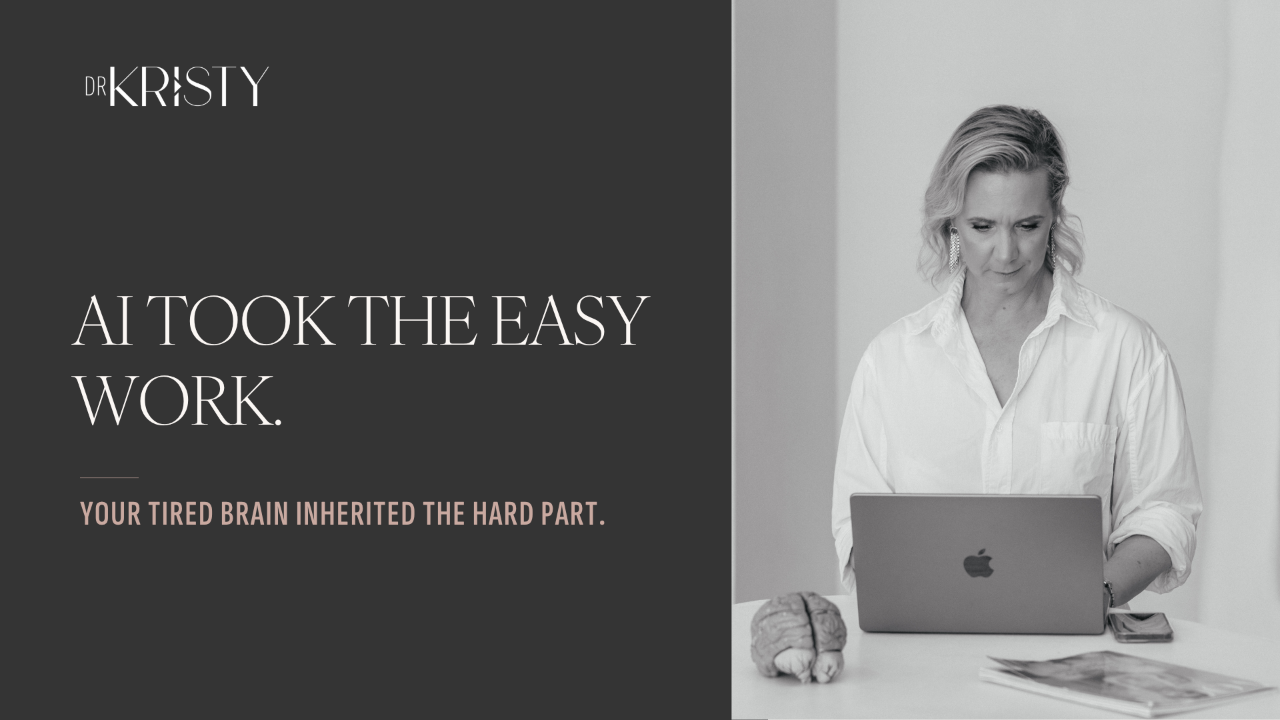
AI took the easy work. Your tired brain inherited the hard part.
Sep 30, 2026At a leadership offsite last month, one of the General Managers told me she can now produce a board paper in around eleven minutes. What she said next is the part I keep coming back to. Proofing, editing and adjusting it takes her hours, and more often than not she does it at 9pm, on too little sleep, with a brain that has already fielded a full day of meetings, messages and mail, not to mention checking and approving a steady stream of AI-generated work (some of it slop) from colleagues.
The production got faster, and the judging landed on her.
This is the quiet shift I see happening inside many organisations rolling out AI. The machines are taking over the production and execution of many tasks. However, what's left is the work that is cognitively demanding. The mentally taxing work like judging the output (because we know AI has been known to hallucinate at times), questioning weak reasoning, applying intimate board member insights or demands, separating real data and perspectives from convincing noise and sensing what may have been omitted in the paper. That residual work is the most cognitively expensive work we do and we are handing it to people who are often running on empty.
The work AI leaves behind runs on your most fragile brain region
Judgement, discernment and synthesising all depend heavily on the prefrontal cortex, the part of your Human Operating System (hOS), your brain, that handles reasoning, inhibition and weighing competing options. It is also the region most vulnerable to stress and sleep loss.
Neuroscientist Amy Arnsten's work showed that even mild uncontrollable stress floods the prefrontal cortex with catecholamines that take it offline, handing control to faster, more reactive and more habitual brain circuits (Arnsten, 2009). In practice, the brain you need for evaluating an AI output is the first one to leave the building when you're depleted. And research is confirming that too many people are currently stressed and/or exhausted.
Tired brains say yes to things that merely look right
AI output is fluent, confident and usually well-formatted, which makes it very easy to accept. Someone recently likened it to a colleague three drinks into the Christmas party: articulate, self-assured and persuasive, occasionally completely wrong, yet entirely convinced they're not.
A 2025 study from Microsoft Research and Carnegie Mellon found that the more confidence people had in generative AI, the less critical thinking they reported applying to its output (Lee et al., 2025). Layer fatigue on top of that and the path of least resistance gets steeper. When biological bandwidth is low, the brain conserves effort and checking something that already looks polished and sounds compelling is exactly the effort it skips.
Researchers studying cancer specialists over a year of AI use described what happens next as "intuition rust", a gradual dulling of expert judgement that stayed invisible while productivity looked strong (Ehsan et al., 2026).
Tired brains misread the room
The other half of the residual work is human. In a study led by Els van der Helm and Matthew Walker, a single night without sleep reduced people's accuracy in recognising emotions in faces, including happiness (van der Helm et al., 2010). Later work from Walker's lab found sleep-deprived brains were more likely to read neutral faces as threatening (Goldstein-Piekarski et al., 2015). The client who looked mildly concerned, the team member who went quiet in the meeting, the smile you were hoping for in the pitch: a tired brain gets those signals wrong, and it gets them wrong with confidence.
It is highly plausible that this could be happening with AI outputs that aren't being properly vetted and checked by depleted employees and leaders.
You are the least reliable judge of how sharp you are
This is the finding I share in almost every room. In Van Dongen and colleagues' study, people restricted to six hours of sleep a night for two weeks showed cognitive deficits comparable to up to two nights of total sleep deprivation, while their own ratings of sleepiness barely moved (Van Dongen et al., 2003). They felt "fine". Their performance said otherwise. I see this with executive coaching clients who tell me they're "fine" and their performance isn't compromised living off four hours of sleep. Their data and colleagues paint a very different picture. So the person signing off the AI-generated client advice or board report at 9pm, on their fourth short night, is also the person least equipped to notice they shouldn't be.
This is the Success Tax of the AI era
Microsoft's telemetry shows people are interrupted roughly every two minutes during core work hours, up to 275 times a day (Microsoft, 2025b), and 80% of the global workforce say they lack the time or energy to do their job well (Microsoft, 2025a). AI hasn't reduced that load. It has changed its composition, removing the easier production tasks and concentrating the day around the hardest thinking we do. For organisations, that is a performance risk with a real price: errors that get signed off, decisions made on plausible-but-wrong analysis, and client relationships quietly misread.
What to do about it
Start by treating judgement as a scheduled task rather than something squeezed in at the end of the day. Your chronotype and ultradian rhythms (roughly 90 to 120 minute cycles of peak and trough) mean you have a Cognitive Prime Time each day, and reviewing AI output belongs in it. Protect a Power-Zone Hour for evaluation work and keep it free of the 3Ms: meetings, messages and (e)mail.
On the day after a bad night, move the highest-stakes judgement calls if you can, and if you can't, build in a second set of eyes. Your own sense that you're coping is the signal to trust least. Piccolo Breaks, 2 to 10 minute recovery breaks, between review blocks help restore enough bandwidth to keep questioning rather than accepting.
For leaders, remember that your tiredness doesn't stay contained. A leader who misreads the room sets the tone for everyone in it.
A Brisbane finance team I worked with through our Amplified program saw team HRV (heart rate variability, which is a biometric measure of how well our bodies are physiologically and psychologically handling the stressors facing us) improve by 22% over a three-month period. One participant put it better than I could: "Tasks that once took me three hours, when done in my peak-performance window and with the strategic use of AI, I can now get them done in 1.5 to 2 hours, and the output is better." That's the combination worth building, smarter machines working alongside Powered-Up humans who are well rested and managing their stress enough to judge what the machines produce and sustain their performance, even in digitally dense days.
If you're thinking about what AI adoption means for your people's capacity, and not just their productivity, this is the conversation I'm having with teams right now in my Powered-Up Performers and Brain Health Dividend keynotes, and I'd love to bring this into your room. Let's start a conversation.
References
Arnsten, A. F. T. (2009). Stress signalling pathways that impair prefrontal cortex structure and function. Nature Reviews Neuroscience, 10(6), 410–422. https://doi.org/10.1038/nrn2648
Ehsan, U., Passi, S., Saha, K., McNutt, T., Riedl, M. O., & Alcorn, S. (2026). From future of work to future of workers: Addressing asymptomatic AI harms for dignified human-AI interaction [Preprint]. arXiv. https://doi.org/10.48550/arXiv.2601.21920
Goldstein-Piekarski, A. N., Greer, S. M., Saletin, J. M., & Walker, M. P. (2015). Sleep deprivation impairs the human central and peripheral nervous system discrimination of social threat. Journal of Neuroscience, 35(28), 10135–10145. https://doi.org/10.1523/JNEUROSCI.5254-14.2015
Lee, H.-P., Sarkar, A., Tankelevitch, L., Drosos, I., Rintel, S., Banks, R., & Wilson, N. (2025). The impact of generative AI on critical thinking: Self-reported reductions in cognitive effort and confidence effects from a survey of knowledge workers. In Proceedings of the 2025 CHI Conference on Human Factors in Computing Systems. Association for Computing Machinery. https://doi.org/10.1145/3706598.3713778
Microsoft. (2025a). 2025: The year the Frontier Firm is born [Work Trend Index annual report]. https://www.microsoft.com/en-us/worklab/work-trend-index/2025-the-year-the-frontier-firm-is-born
Microsoft. (2025b, June 17). Breaking down the infinite workday [Work Trend Index special report]. https://www.microsoft.com/en-us/worklab/work-trend-index/breaking-down-infinite-workday
van der Helm, E., Gujar, N., & Walker, M. P. (2010). Sleep deprivation impairs the accurate recognition of human emotions. Sleep, 33(3), 335–342. https://doi.org/10.1093/sleep/33.3.335
Van Dongen, H. P. A., Maislin, G., Mullington, J. M., & Dinges, D. F. (2003). The cumulative cost of additional wakefulness: Dose-response effects on neurobehavioral functions and sleep physiology from chronic sleep restriction and total sleep deprivation. Sleep, 26(2), 117–126. https://doi.org/10.1093/sleep/26.2.117
Ready to stop paying the success tax and start living as a high-res human?
Neuroscience-backed insights on focus, energy and sustainable performance, delivery occasionally. Practical insights for ambitious people who don't want burnout to be the cost of success.
By subscribing, you'll receive emails from Dr Kristy. You can unsubscribe anytime.